
Affiliate Disclosure: Some of the links in this post are affiliate links. This means we may earn a small commission if you make a purchase through these links—at no extra cost to you. We only recommend products and tools that we genuinely believe will help you with your sewing projects.
You’ll master menswear sewing faster with beginner-friendly patterns featuring straightforward construction and clear sizing. Start with forgiving fabrics like jersey knit for simple t-shirts and casual wear that build confidence quickly. Progress to loungewear and pajamas using elastic waistbands and minimal seaming. These foundational projects teach essential skills—button attachment, hemming, and consistent stitching—without overwhelming complexity. Once you’ve mastered these basics, structured pieces like vests and layering garments become your next natural stepping stone.
Key Takeaways
- Start with simple t-shirt patterns using forgiving fabrics like jersey knit to build confidence quickly.
- Master basic skills through loungewear projects like elastic waistband pajama pants with minimal seaming required.
- Use clear size charts and finished garment measurements included in beginner patterns to ensure proper fit.
- Progress to structured pieces like vests and waistcoats after mastering foundational techniques from basic projects.
- Organize your workspace with proper lighting, storage bins, and cutting tools to work efficiently on projects.
Why Men’s Sewing Patterns Are the Perfect Entry Point
If you’re new to sewing, men’s patterns offer a straightforward pathway to success. You’ll find that men’s patterns feature uncomplicated construction techniques that eliminate unnecessary steps, making them ideal for beginners enthusiastic to build foundational skills. Unlike intricate garments, these designs prioritize functionality and simplicity.
You’ll benefit from clear size charts and finished garment measurements included in most men’s patterns, allowing you to achieve proper fit while experimenting with personalized adjustments. Designs like Woodsia Shorts and Banksia Pants showcase elastic waistbands that streamline the sewing process further.
Clear size charts and finished garment measurements help you achieve proper fit while experimenting with personalized adjustments.
Men’s patterns aren’t exclusively beginner territory—experienced sewists appreciate their versatility too. You’ll access digital PDF formats instantly, enabling flexible scheduling and immediate printing.
This variety spans casual wear to formal attire, providing continuous learning opportunities while you create genuinely wearable garments.
Beginner Skills Every Sewer Needs (and When to Learn Them)
Now that you’ve chosen a beginner-friendly pattern, you’ll want to build the foundational skills that’ll make your projects successful. Start by mastering button sewing—it’s essential for maintaining garments and strengthens your hand technique.
Next, learn fabric identification and proper needle selection; ballpoint needles work best for knit fabrics used in t-shirts and pajama pants. Familiarize yourself with patterns for men by beginning with simple designs like tees and shorts, which require fewer fastenings and deliver quick results.
Practice fundamental techniques through manageable projects such as drawstring bags and wallets before advancing to complex garments. Leverage online tutorials and community support to navigate common challenges.
This structured approach guarantees you’ll develop robust beginner skills while building confidence with your patterns for men.
Your First Project: Simple T-Shirts and Casual Wear
You’ll build sewing confidence fastest when you start with forgiving fabrics like knits, which accommodate minor mistakes and deliver professional results despite imperfect seams.
Simple t-shirt patterns designed for beginners use these approachable materials, allowing you to focus on mastering fundamental techniques rather than wrestling with difficult fabric behavior.
Forgiving Fabric Choices
Three fabric types stand out as ideal starting materials for beginner sewers: jersey knit, cotton blends, and lightweight fleece.
You’ll appreciate how these forgiving fabrics stretch and move, accommodating minor measurement errors without compromising your finished garment’s wearability.
Jersey knit’s inherent elasticity allows you to work with relaxed seam tolerances while maintaining comfort and fit.
Cotton blends offer similar forgiveness with added breathability, making them versatile for various seasons.
Lightweight fleece provides structure without rigidity, simplifying construction techniques.
These materials pair perfectly with beginner-friendly patterns designed for t-shirts and casual wear.
You’ll navigate seam attachments and hem finishing more confidently when your fabric cooperates rather than resists.
Their forgiving nature transforms learning opportunities into successful projects, building your sewing foundation systematically.
Building Sewing Confidence
Your first sewing project should be a simple t-shirt constructed from forgiving jersey fabric, which allows you to master fundamental techniques without traversing complex construction methods.
Beginner-friendly patterns designed for casual wear provide clear size charts and straightforward instructions that demystify garment construction.
As you complete your initial project successfully, you’ll build confidence in your abilities. These patterns emphasize comfort and movement, enabling you to express personal style while developing essential skills.
The manageable scope prevents overwhelming frustration, allowing you to focus on learning proper seam allowances, neckline finishing, and sleeve attachment.
Online tutorials specific to t-shirt construction offer valuable support when you encounter challenges. This structured approach transforms sewing from an intimidating activity into an achievable goal, establishing the foundation for advancing toward more complex garment projects.
Build Confidence: Loungewear, Pajamas, and Shorts
Once you’ve mastered basic t-shirts, you’ll find that loungewear essentials like the S3205 Unisex Lounge Pants and M8636 Pull On Pants offer the next logical step in building your sewing confidence through straightforward construction techniques.
Pajama patterns such as the S3204 Unisex Pajamas use soft knit fabrics and minimal seaming, allowing you to practice essential skills without overwhelming complexity.
Simple shorts like the Woodsia Shorts round out this category with their elasticated waistbands and knee-length designs, giving you practical projects that reinforce foundational techniques while producing wearable results.
Comfortable Loungewear Essentials
When you’re building sewing confidence, loungewear projects offer the perfect foundation—they’re forgiving, functional, and immediately wearable.
Free men’s sewing patterns like the S3205 unisex lounge pants and S3204 pajamas ($16.07 each) provide straightforward construction ideal for beginners. These patterns emphasize ease of movement with elasticated waistbands and simplified seaming.
You’ll appreciate how loungewear adaptability enhances your skill development. The S3205 design accommodates fabric variations, allowing you to customize comfort levels while mastering basic techniques.
Simple shorts patterns featuring pockets and elastic waistbands offer similar beginner-friendly construction.
Pajama Patterns For Beginners
Building on these loungewear fundamentals, pajama patterns like the S3204 and S3205 offer an ideal next step for developing sewing competency.
You’ll work with beginner-friendly designs that build your confidence through manageable construction.
These patterns equip you with essential skills:
- Elasticated waistband installation: Master the technique of inserting elastic for a comfortable, forgiving fit
- Basic hemming: Practice finishing techniques on pajama pants legs with precision
- Seam stitching: Develop consistent stitch quality through straightforward seams
- Fabric handling: Learn to work with soft knits and woven materials that enhance comfort
You’ll practice fundamental sewing techniques while creating practical garments for personal use.
The clear instructions and size charts guarantee proper fit throughout your project.
These patterns transform basic skills into wearable pieces, establishing confidence for advancing to more complex men’s sewing projects.
Simple Shorts Construction Guide
As you’ve mastered basic pajama construction, shorts patterns like the Woodsia Shorts offer your next progression—combining elasticated waistbands with multiple pockets and straightforward seaming.
These beginner-friendly designs build confidence by introducing practical construction elements without overwhelming complexity.
The Banksia Pants pattern advances your skills further, incorporating drawstring waistbands and zippers—essential techniques for tailored loungewear.
You’ll develop precision handling these closures while maintaining comfort-focused design principles.
Focus on fit customization using simple patterns like Basic Trousers. This hands-on approach lets you experiment with proportions and styling choices, strengthening your technical foundation.
Elastic waistbands remain your ally, streamlining construction while emphasizing proper seaming techniques.
These uncomplicated shorts projects establish core capabilities, preparing you for increasingly complex garments like tailored shorts or complete pajama sets.
Add Structure: Vests, Waistcoats, and Layering Pieces
Once you’ve mastered basic garment construction, vests and waistcoats offer the perfect next step—they’ll build your structural sewing skills without overwhelming complexity. These layering pieces elevate any outfit while remaining accessible for beginners.
Start with patterns like the S3172 Vest, which provides structured guidance for customization:
- Choose lightweight fabrics to guarantee comfort and unrestricted movement
- Practice interfacing techniques to create crisp, professional finishes
- Master slip stitching for clean, invisible seams on waistcoats
- Experiment with design variations like pockets and button styles
You’ll develop confidence handling garment construction fundamentals while creating versatile pieces suitable for formal and casual occasions.
Vests and waistcoats demand precision in pattern cutting and fitting, establishing essential skills you’ll apply to more complex garments. This progression transforms your sewing capabilities systematically.
Tackling Outerwear: Jackets and Coats for Intermediate Sewers
You’ll master jacket construction by understanding how collars, lapels, and seams work together to create structure and shape.
As you progress, you’ll need to select fabrics that support your design—heavier materials like wool and canvas provide durability for utility styles, while lighter options offer flexibility for casual jackets.
These foundational skills in construction and fabric selection prepare you to tackle patterns like the ME2152 Utility Trench Coat with confidence.
Jacket Construction Basics
Five critical elements determine whether your jacket’ll fit well and last: fabric selection, pattern choice, component understanding, interfacing application, and technique mastery.
For successful jacket construction, you’ll need to master these foundational aspects:
- Fabric Selection: Choose heavier materials like canvas or denim for structure, or lighter cotton blends for comfort and movement.
- Pattern Quality: Follow well-drafted patterns designed for intermediate sewers to guarantee better fit and clearer instructions.
- Component Knowledge: Understand collars, sleeves, pockets, and closures—each influences your mens jacket’s style and functionality.
- Interfacing Application: Use interfacing strategically on collars and lapels to enhance durability and achieve a polished finish.
Additionally, familiarize yourself with outerwear-specific sewing techniques like reinforced seams and topstitching. These methods strengthen your jacket and extend its longevity considerably, making sure your investment in quality construction pays dividends.
Choosing Appropriate Fabrics
Because outerwear demands durability and weather resistance that casual garments don’t require, fabric selection becomes your most critical decision in jacket and coat construction.
You’ll want to choose heavier materials like denim, canvas, wool, or synthetic blends that provide both warmth and structural support. Select water-resistant or weatherproof fabrics to enhance performance and longevity, particularly for trench coats and bombers. Sturdier fabrics create the tailored structure essential for professional-looking jackets.
However, don’t overlook stretch options like softshell or performance knits—they’ll give you better mobility without sacrificing durability.
Finally, consider your lining fabric carefully. You can opt for lightweight rayon or cotton if breathability matters, or choose fleece for additional warmth in colder climates. These choices directly impact both functionality and comfort.
Understand Seam Allowances, Fit, and Pattern Sizing
Before you cut into your fabric, it’s critical that you understand three foundational concepts: seam allowances, pattern sizing, and fit.
Seam allowances are the extra fabric built into patterns for stitching, typically ranging from ¼ inch to 5/8 inch. You’ll find specifics in your pattern instructions.
Seam allowances are extra fabric built into patterns for stitching, typically ranging from ¼ inch to 5/8 inch.
Pattern sizing requires you to take accurate measurements—chest, waist, and hip—then compare them against the pattern’s size chart. This step prevents costly mistakes.
Consider these essential elements:
- Finished garment measurements help you assess how the garment will actually fit your body.
- Ease allowance provides comfort and movement between your body and the garment.
- Personal adjustments accommodate your unique shape and style preferences.
- Gradual seam allowance modifications let you customize fit without redesigning the entire pattern.
Taking time to understand these concepts guarantees your finished garments fit properly.
Match Your Fabric to Your Skill Level
Choosing the right fabric for your skill level is essential to your success as a beginner sewer. You’ll want to start with woven fabrics like cotton or cotton blends, which provide structure and forgiveness as you develop your techniques.
Lightweight options such as cotton lawn and broadcloth accommodate mistakes while producing quality garments that experienced sewists alike appreciate.
Avoid slippery or complex fabrics like satin and silk until you’ve gained confidence. These materials demand advanced handling skills you haven’t yet mastered. Beginner-friendly patterns typically recommend cotton for good reason—it’s forgiving and manageable.
Select projects that complement fabric choices: simple shirts or tote bags work perfectly with structured wovens. This strategic pairing accelerates your learning curve while ensuring successful finished projects that build your confidence and capabilities.
Adapt Patterns to Your Measurements
Once you’ve selected your beginner-friendly fabric, you’ll need to confirm your pattern actually fits your body. Take accurate measurements of your chest, waist, hips, and inseam, then compare them directly to your pattern’s size chart. This essential step prevents costly mistakes and guarantees proper garment fit.
Key measurement points to address:
- Chest measurement: Compare against the pattern’s finished chest width to determine if you need to size up or down.
- Waist and hip measurements: Identify discrepancies that require adding or removing material at seams.
- Inseam length: Measure from your crotch to ankle to establish correct pant or sleeve length.
- Pattern adjustment method: Use tracing paper to modify patterns, preserving originals while experimenting with different fits.
Make basic adjustments—like lengthening sleeves or shortening hems—before cutting fabric to achieve your personalized fit.
Troubleshoot Common Beginner Mistakes
Even experienced sewers encounter predictable pitfalls, but you can sidestep most common beginner mistakes by understanding their root causes.
When sewing men’s clothing, you’ll often struggle with fit issues stemming from inaccurate measurements or incorrect seam allowances. Always verify your fabric orientation and pattern placement before cutting to prevent costly waste.
Select the appropriate needle for your fabric type—using the wrong one causes skipped stitches or damage. Test your machine settings on scrap fabric first, ensuring proper tension and stitch quality.
Consult your size chart carefully when choosing your pattern size. Double-check seam allowances against your pattern specifications; even small deviations compound across garment pieces, resulting in pieces that don’t fit properly.
Organize Your Workspace and Supplies
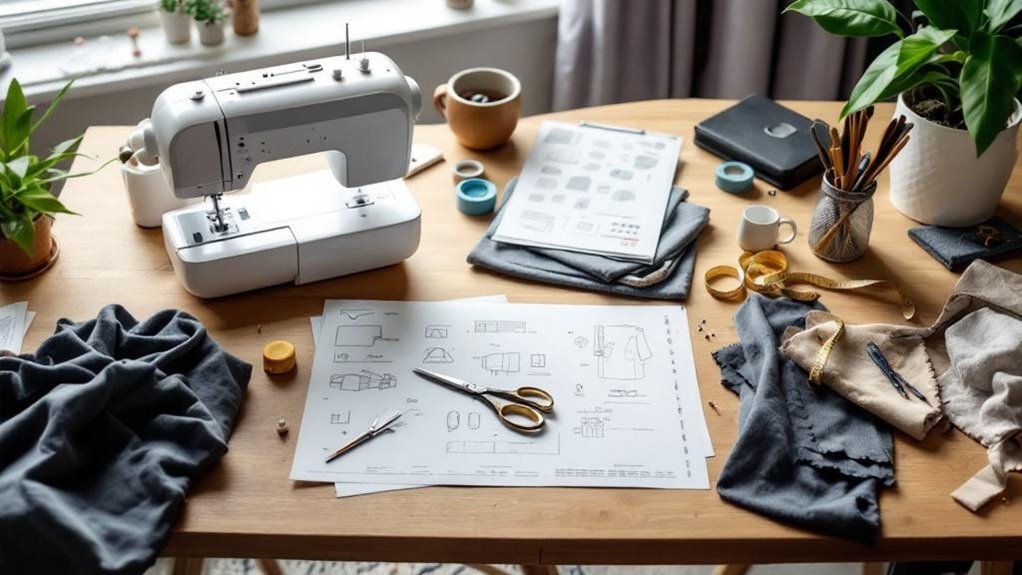
Now that you’ve mastered troubleshooting common mistakes, you’ll find that a well-organized workspace prevents many of those errors before they start. Designate a well-lit area free from distractions to enhance your focus on men’s sewing patterns.
Organize your supplies strategically:
- Clear storage bins categorize fabrics, threads, and tools for quick access
- Cutting mat and rotary cutter create a safe, efficient preparation zone
- Dedicated sewing machine section equipped with needles and presser feet for rapid adjustments
- Regular decluttering removes unused materials, maintaining workspace efficiency
This systematic approach streamlines your sewing sessions. You’ll locate supplies instantly, reduce setup time, and concentrate entirely on your project.
A properly arranged workspace supports precision work—critical when learning men’s garment construction. Your organized supplies and dedicated space directly impact your success as a beginner sewer.
Plan Your Next Project: A Year of Menswear
Your organized workspace sets the stage for executing a structured progression of beginner menswear projects throughout the year. Start with foundational pieces like T-shirts and pajama pants to establish core sewing skills before advancing to complex garments.
Select versatile patterns such as the S3205 Unisex Lounge Pants or M8638 Double Breasted Jacket that you’ll adapt seasonally for different occasions.
Plan your next project strategically by utilizing digital PDF patterns for convenient access and immediate printing. This approach lets you start projects spontaneously when inspiration strikes.
Incorporate sustainability by repurposing old clothing into drawstring bags or wallets, reducing waste while building proficiency.
Engage online sewing communities to document your progress and gather specialized tips for men’s clothing construction. Their collective knowledge accelerates your skill development markedly.
Frequently Asked Questions
What Sewing Machines and Tools Do I Need to Start My First Project?
You’ll need a sewing machine, thread, fabric scissors, pins, needles, measuring tape, and a pattern. You’ll also want a seam ripper, iron, and pressing board for professional results.
Where Can I Find Affordable Quality Fabrics Suitable for Beginner Men’s Sewing Projects?
You’ll find affordable quality fabrics at fabric stores like Joann, local quilt shops, and online retailers such as Etsy and Amazon. You should choose cotton blends and linen for beginner projects—they’re forgiving and budget-friendly.
How Long Does It Typically Take to Complete a Basic Men’s Garment?
You’ll typically complete a basic men’s garment in 4-8 hours, depending on complexity. Simple projects like pajama pants take 4 hours; shirts require 6-8 hours. Your speed improves with practice and pattern familiarity.
Can I Modify Existing Store-Bought Clothes Using Sewing Pattern Techniques?
You can modify store-bought clothes by applying pattern techniques like taking in seams, adjusting sleeve length, and tapering legs. You’ll need basic tools: seam ripper, measuring tape, pins, and needle. Start with simple alterations before tackling complex restructuring.
What Resources or Communities Offer Support and Feedback for Beginner Sewers?
You’ll find vibrant support online through Reddit’s r/sewing community versus local fabric shops offering in-person guidance. YouTube channels provide free tutorials while Craftsy classes deliver structured instruction. Join Facebook groups where you’ll receive direct feedback on your projects.
Conclusion
You’ve learned the fundamentals. You’ve mastered basic stitches. You’ve completed your first garment. Now you’ll refine your techniques, you’ll expand your pattern library, and you’ll build your signature style. Each project strengthens your skills, each pattern teaches you something new, and each garment you wear proves you can create quality menswear. You’re ready to sew confidently, to experiment boldly, and to become the skilled tailor you’ve always wanted to be.